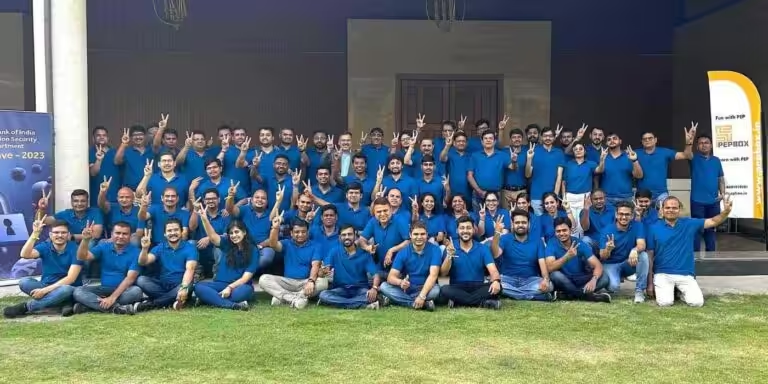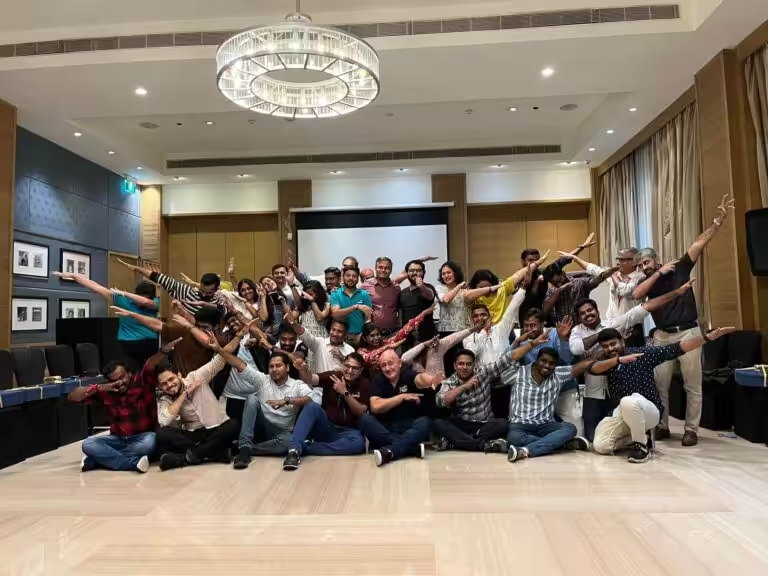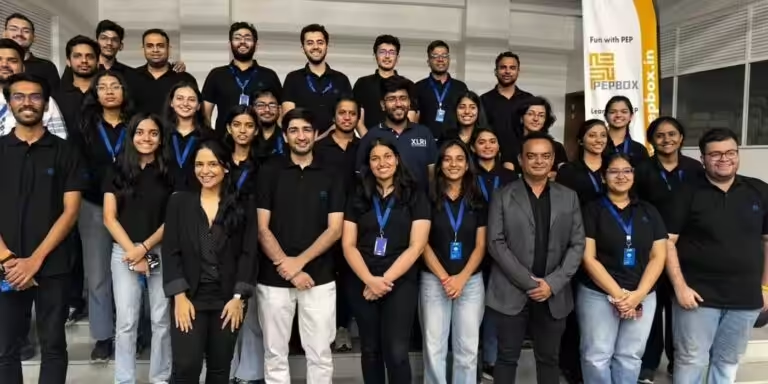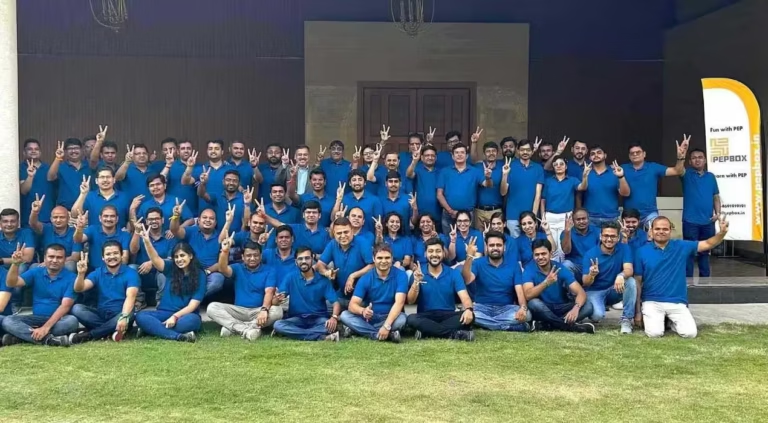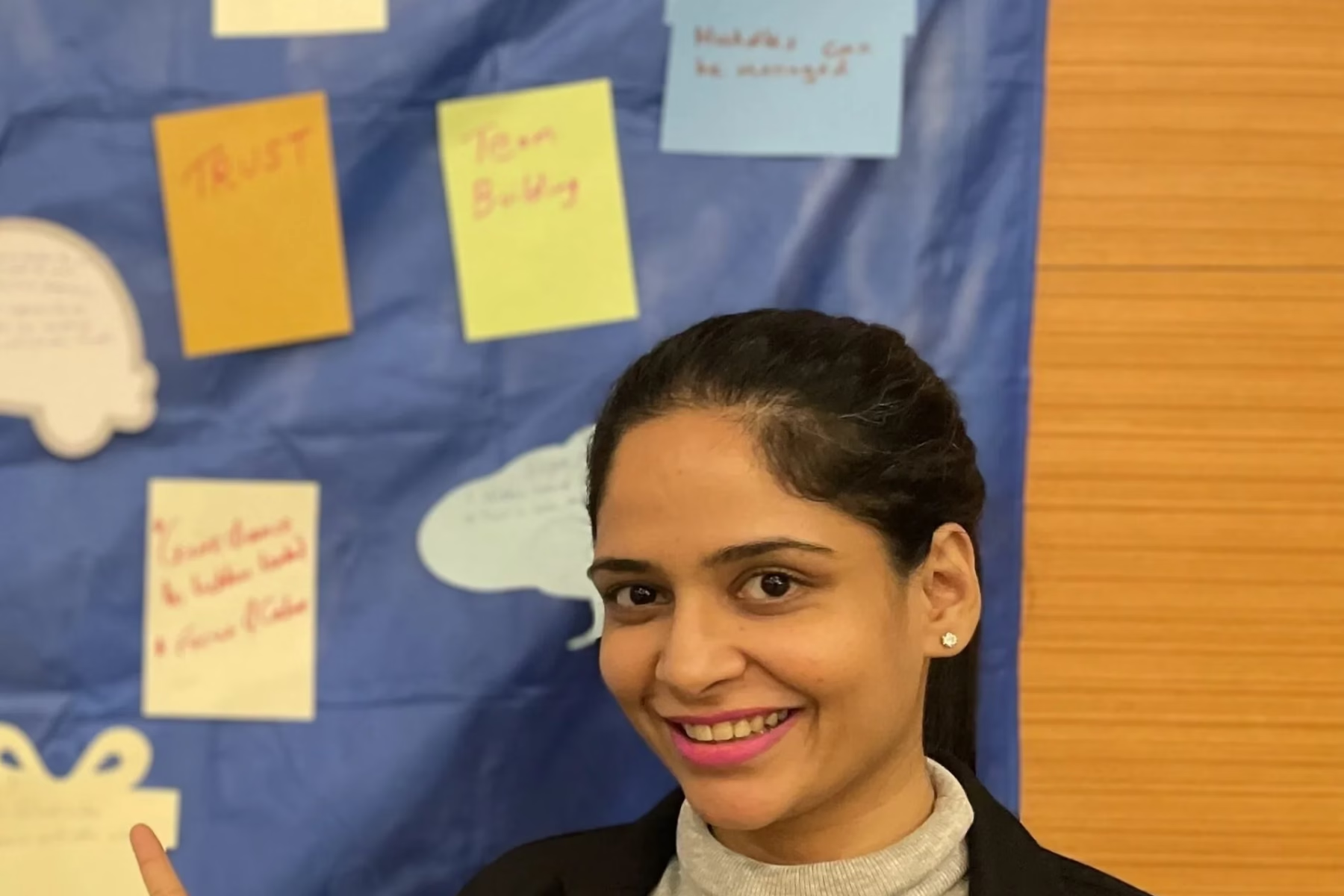
At a workshop we ran in Vadodara for about 25 people, the part people remembered afterwards was not the activities. It was the discussion that followed them, when people began to connect what they had just done to the way they work every day. That is experiential learning at work in a single session.
This guide explains what the term means, how a session runs, and what it looks like with real activities, so you can judge whether it fits your next training day.
What experiential learning means
The idea is simple: people learn more from doing something and thinking about it than from being told. The best-known model comes from David Kolb’s 1984 book Experiential Learning: Experience as the Source of Learning and Development, which describes a cycle of four stages (summary from the University of Florida). In plain words:
- Do something. The team takes part in a task with a real goal and real limits.
- Look back at it. People describe what happened, from their own point of view.
- Make sense of it. The group works out what the experience says about how they work.
- Try it differently. People decide what they will do differently, in the next round or back at work.
In a classroom, the trainer gives the answer and the group listens. In an experiential session, the group finds the answer itself, and that is why it sticks.
How a session runs
A typical session moves through the same steps, whatever the activity:
- Brief: the facilitator explains the task and the rules, and says nothing about the lesson.
- Activity: 15 to 120 minutes, depending on the format.
- Debrief: 15 to 30 minutes of guided discussion, ideally in a circle and straight after the activity.
- Link to work: the group names one or two things it will change, in its own words.
Before any of this, we agree the objective with the client. Our experiential learning programmes start from the group and its challenges, then the objectives, then the choice of activities that carry each learning point. Facilitators run the activities and the debriefs, and the programme closes with a summary of what the group worked out.
Example 1: giving clear instructions
In Blind Folded Tent Assembly, blindfolded team members put up a camping tent while a nominated leader guides them by voice alone. It takes 30 to 45 minutes for 10 to 150 people. The first few minutes are usually chaos: “put that pole there” means nothing to someone who cannot see “there”.
In the debrief: which instructions worked, and which ones did the leader think were clear? What did the builders need that they did not ask for? At work: briefings, handovers between shifts, and any instruction given by email to someone who was not in the room.
Example 2: sharing what you have
Perfect Squares gives each player in a team of five a set of shapes, and every player has to complete a square of the same size, without speaking. It takes only 15 to 20 minutes. Someone usually finishes a square early and sits back, not noticing that the team cannot finish unless they break it up and give a piece away.
In the debrief: who noticed someone else’s problem? What stopped you from giving up a piece? At work: targets set by department, teams that guard their own resources, and the gap between finishing your part and the job being done.
Example 3: planning with limited material
In Pyramid Building, teams receive a fixed set of materials, plan how to use them and build a stable pyramid, layer by layer. It takes 90 to 120 minutes for 20 to 300 people. Chain Reaction goes a step further: each team builds one section of a Rube Goldberg style contraption, and the final run only works if every section hands over to the next.
In the debrief: how long did you plan before you started building? Who decided, and how? What did you agree with the teams on either side of you? At work: project planning, roles, and the hand-offs between departments where most projects slip.
-
 Blind Folded Tent Assembly
Lesson learned: ‘that one’ means nothing when your whole team is blindfolded.
30 to 45 min 10 to 150 people
-
 Perfect Squares
Rule one: make five identical squares. Rule two: no talking. Rule three: you can only give, never take.
15 to 20 min 10 to 200 people
-
 Pyramid Building
No pharaoh ever built a pyramid alone. Neither will your team.
90 min to 2 hours 20 to 400 people
Example 4: decisions under pressure
Business simulations bring the lesson closer to the day job. In Market Share Challenge, teams compete for the biggest share of a market with limited resources, and the conditions change during the game. It takes 45 to 60 minutes for 20 to 100 people. Wolf of Wall Street is a stock market simulation in which teams read market news and trade to build a portfolio, for 30 to 500 people.
In the debrief: when the market changed, how long did your team take to change its plan? Who had information that the team did not use? At work: how a team reacts to new data, and whether people speak up when they see a risk.
Example 5: learning from other people’s mistakes
In The Leadership Maze, there is one safe path across a grid on the floor. Players take turns, and one wrong step sends them back to the start. The team only gets across if people watch closely and remember every step already tested.
In the debrief: did the team learn from each wrong step, or did people repeat them? How did it feel to be the one who stepped wrong? At work: how a team treats mistakes, and whether people share what went wrong so others do not repeat it.
-
 Market Share Challenge
Market alert: rivals are rising, resources are shrinking and every decision counts.
45 to 60 min 20 to 100 people
-
 Wolf of Wall Street
Ticker: teamwork up, panic down, profits climbing fast. Pepbox’s Wolf of Wall Street is a stock market simulation where…
60 to 90 min 30 to 500 people
-
 The Leadership Maze
Leadership is finding a path nobody can see yet. In Leadership Maze, Pepbox’s hidden-grid challenge, every teammate…
20 to 40 min 10 to 100 people
Example 6: promising and delivering
Commitment Challenge is short, 20 to 30 minutes for 10 to 300 people. After a warm-up, each participant commits to a target, such as landing balls in boxes at different distances. Then they have to hit it in front of everyone, with a few surprises along the way.
In the debrief: did people choose safe targets or stretch ones, and why? What happened to the team when someone missed? At work: how targets are set, the habit of promising too much or too little, and how a team responds when someone falls short.
The debrief is where the learning happens
If you remember one thing from this guide, make it this: an activity without a debrief is a game. A simple structure that works for most groups uses three questions, often credited to Rolfe, Freshwater and Jasper (2001):
- What? What happened, step by step? Get several people to describe it, because each saw something different.
- So what? What does it say about how we work? Where have we seen the same thing in the office?
- Now what? What will we do differently from Monday? Keep it to one or two points the team chooses itself.
A good facilitator asks and listens more than they talk. If the group reaches a point on its own, it will remember it. If the facilitator announces it, most people will forget it by lunch.
Making it last after the workshop
The workshop is the start. In my experience, the teams that get the most out of a session do three small things afterwards:
- They write down the group’s commitments in the group’s own words and send them round the next day.
- They keep the shared language. “Remember the tent” becomes a quick way to say that an instruction was not clear, and nobody needs it explained.
- They check back after about a month, in a regular team meeting: what changed, and what slipped back.
Choosing activities for your objective
Start with the objective, then pick two or three activities that carry it. Our lists are sorted that way: collaboration, problem solving, strategic thinking and creativity. For a programme away from the office, see outbound training.
A few mistakes to avoid:
- Running activities back to back with no debrief in between, because the agenda is full.
- Choosing an activity because it looks fun, when it does not connect to the objective.
- Leaders who watch instead of taking part. The team notices, and the debrief loses its honesty.
- Cutting the debrief when lunch runs late. It is the part that turns the session into learning.
If you are planning a workshop, tell us the group, the objective and the time you have, and we will suggest a programme and the activities that carry each point.