Walk past a hall where a drum circle is under way, and you hear it before you see it. A few hundred people, most of whom have never played a drum, are keeping one steady beat. The first minute is usually hesitant. By the end, the room is playing as one group and following a single facilitator’s signals.
So what is a drum circle, exactly, and what happens between that first hesitant minute and the end? This guide explains the format, a session minute by minute, and what you need to arrange if you are thinking of one for your team. We run corporate drum circles for groups as different as a conference hall and a club of senior citizens, and neither needed any musical experience.
Drum circle, drum class or performance
The phrase “drum circle” covers a few different things, and it helps to separate them.
- An informal or community circle has no leader. People bring drums, sit together and improvise.
- A facilitated drum circle has a facilitator who sets up the space and the instruments and guides the group with spoken and hand signals for starting, stopping and changing volume (Wikipedia describes both kinds).
- A drum class teaches technique over several sessions.
- A performance is something the audience watches.
A corporate drum circle is the second kind. Everyone plays, nobody is taught technique for its own sake, and the aim is for the whole group to play together within one session.
What happens in a session, minute by minute
A session of 35 to 45 minutes usually moves through five stages. The facilitator adjusts the timings to the group, so treat the minutes as a guide.
| Stage | About | What happens |
|---|---|---|
| Drums and basics | 5 min | Everyone takes a djembe or a percussion instrument. The facilitator shows how to hold it and how to play a low bass note and a higher tone. |
| Find the pulse | 7 min | The facilitator starts a steady beat and the group joins in. Simple signals for stop, start, louder and softer come in here. |
| Build the rhythm | 12 min | Sections such as drums, shakers and bells add their layers one at a time, while the facilitator shapes the overall sound. |
| Call and response | 8 min | The facilitator plays short phrases for the group to answer, then hands the lead to volunteers and sections. |
| Finale | 5 min | The whole group plays one beat together, builds it up and ends on the facilitator’s cue. |
The finale is the moment most people remember: a room full of colleagues stopping on the same beat, on one signal.
The instruments
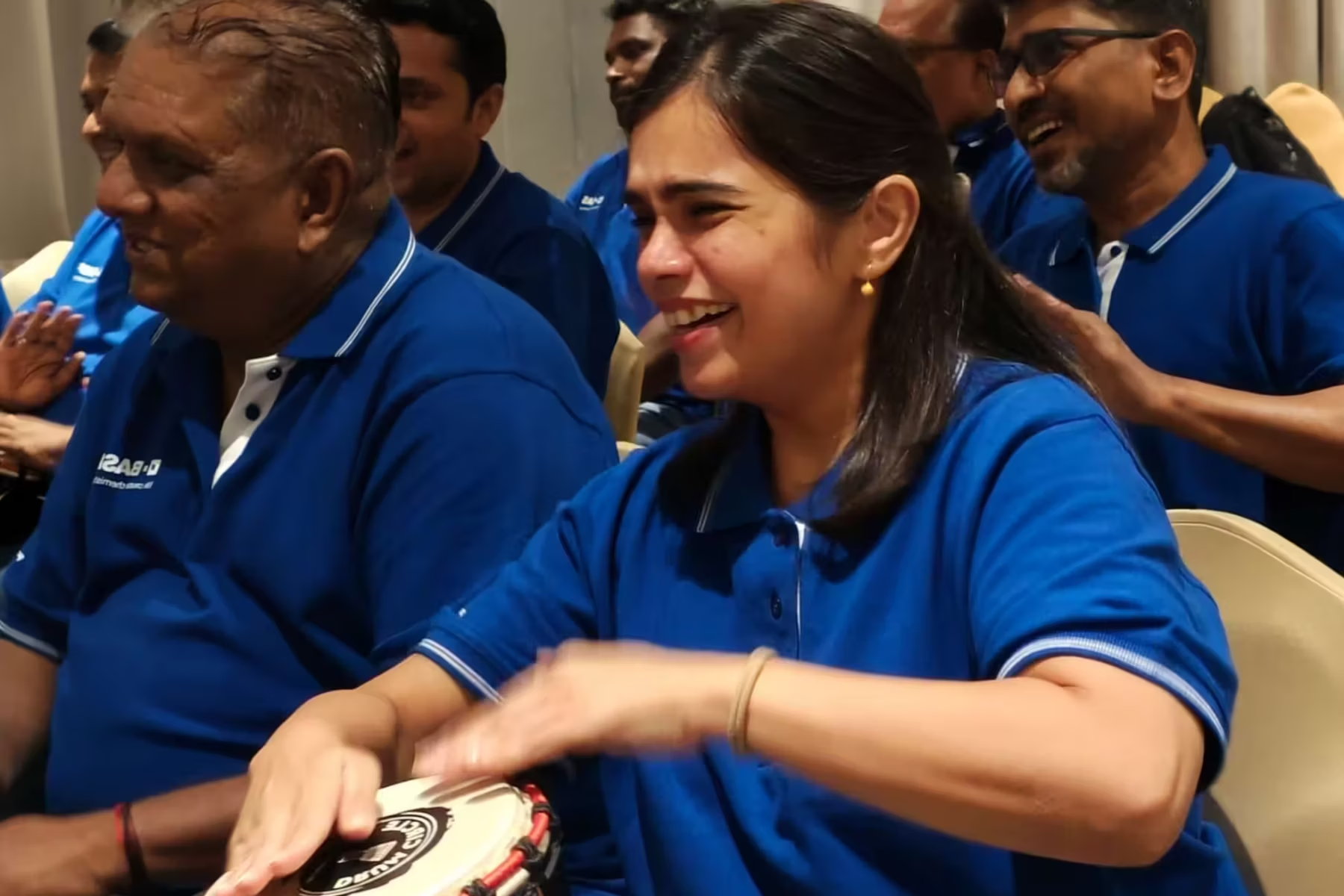
The main instrument is the djembe, a goblet-shaped hand drum from West Africa, played with bare hands. Hitting the centre gives a deep bass note, and hitting near the edge gives a higher, sharper tone, so even a beginner can play two clear sounds within a minute. Around the djembes, some people play shakers, bells and other percussion, which gives the facilitator different sections to bring in and out.
People play seated, with the drum held between the knees or tilted slightly away. Everyone gets an instrument, so nobody ends up watching.
What the facilitator does
The facilitator is the difference between a pleasant noise and a group playing together. During the session, they do five things:
- They start and stop the whole room with clear hand signals, and change the volume the same way.
- They split the group into sections and bring each one in at the right moment.
- They lead call and response, then hand the lead to volunteers from the group.
- They watch the room, and slow down or lift the energy as needed.
- They keep to the time slot, which matters at a townhall with a full agenda.
How many people can join
A drum circle works for any group from 10 people to over 2,000. With a team of 20, it can sit in a true circle in a meeting room. With a few hundred, it usually runs in rows or a horseshoe in a hall, with the facilitator on a stage.
The bigger the group, the more planning it needs: more drums, more facilitators, and a sound system with microphones so that everyone can hear the facilitator. Seating, and how drums reach every seat and come back, also need thought for large groups. Our guide to planning a drum circle for a townhall or conference covers these in detail.
Where it works
Companies use drum circles in many settings:
- At the office, for a team break, a Fun Friday or a festival celebration.
- To open or close a conference or townhall.
- At offsites and team outings, often as the last activity of the day.
- At family days, where children and grandparents can play too.
- As a first shared activity for a batch of new joiners.
We run them across India, and our city pages for Mumbai, Bangalore and Delhi show sessions in each city.
What people worry about beforehand
The question I hear most often before a session is whether people will actually join in. They do, mostly because there is nothing to get wrong. A bass note and a tone are all anyone needs, and the sound of the whole room covers any single mistake.
The second worry is that senior leaders will feel awkward. In practice, a leader playing a drum in the same row as everyone else tends to put the rest of the room at ease. If your leaders are willing, seat them among the group rather than in the front row.
The third is comfort. Anyone with a wrist or hand injury can play a shaker instead of a drum, and anyone sensitive to noise can sit further back. Tell the facilitator beforehand, and it is easy to arrange.
What you arrange and what we bring
We bring the facilitators and the drums and percussion instruments for everyone, and set up and run the session. You arrange an open or semi-open space or a large room, basic seating, and a sound system with microphones suited to the size of the group. If the session is outdoors, add shade and drinking water, and a covered back-up space in case of rain.
Why companies choose drum circles
The reasons we hear most often are practical. A drum circle brings a large group together quickly, needs no skill or preparation from participants, works across ages and roles, and fits into a 35 to 45 minute slot. Companies use it for team bonding, for a break in a long day, or to open or close an event.
There is also some research on doing things in time with other people. In experiments by Wiltermuth and Heath (2009), people who had walked in step or moved in time to music with others cooperated more afterwards in a game than people who had not (ScienceDaily summary). Those were short tasks in a laboratory, not drum circles at work, so we treat them as an explanation of why the format feels the way it does, not as a promise of results.
Similar formats
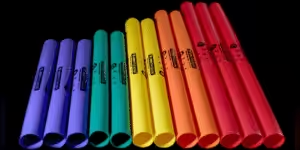
If a drum circle is not quite right, two other formats work on the same idea. Body Percussion uses no instruments at all: people clap, tap, snap and stamp to one beat, in 20 to 25 minutes, for 50 to 5,000 people. Boombastic is played on Boomwhackers, colourful tubes tuned to different notes, for 50 to 2,500 people. For a calmer music session, Harmonica teaches everyone simple patterns on their own harmonica. See all our music and creativity activities.
-
 Body Percussion
Ever noticed you carry a full drum kit everywhere? Pepbox’s Body Percussion Experience turns claps, stomps and snaps…
20 to 25 min 50 to 5,000 people
-
 Boombastic
Do. Re. Mi. You hold one note, your colleague holds the next, and together you make real music.
30 to 40 min 50 to 2,500 people
-
 Harmonica
The workshop ends. The music doesn’t. In Pepbox’s Harmonica Workshop, your team learns to play in harmony, no…
25 to 30 min 30 to 1,000 people