Once you have decided on a drum circle for a townhall or conference, the questions change. It is no longer about whether people will enjoy it. It is about where 600 drums go before the session and how they reach every seat. Can the people in the back row see the facilitator? What happens to the agenda if collection takes ten minutes longer than planned?
This guide covers those questions. If you are still deciding whether a drum circle fits your event, start with our explanation of what a drum circle is and how a session works. Then come back here to plan.
Where it fits in the agenda
A drum circle changes the energy in a room, so place it where you need that change.
- As the opener. People arrive from different teams and cities, and a shared beat in the first hour turns a crowd into one audience.
- Straight after lunch. This is the slot where energy is lowest and speakers struggle most.
- As the closer. It ends the day with everyone doing the same thing at the same moment, which suits an annual day or an awards night.
Avoid placing it just before a serious or sensitive session, such as results or an organisational change. The room needs a few minutes to settle after a drum circle, and the contrast can feel awkward. For other formats that fit a packed agenda, see our list of activities for conferences and townhalls, and for awards events, rewards and recognition activities.
How much time to block
The session itself takes 35 to 45 minutes. On top of that, you need time to get drums into people’s hands and back again. How long that takes depends on the headcount, the layout and whether drums are placed on seats before people walk in. Agree it with the facilitator when you plan the agenda, and put it in the run sheet as its own line.
If your agenda is tight, ask about placing drums on the seats in advance. It saves the handout time, but it needs the hall to be free for set-up before the session starts.
Seating and layout
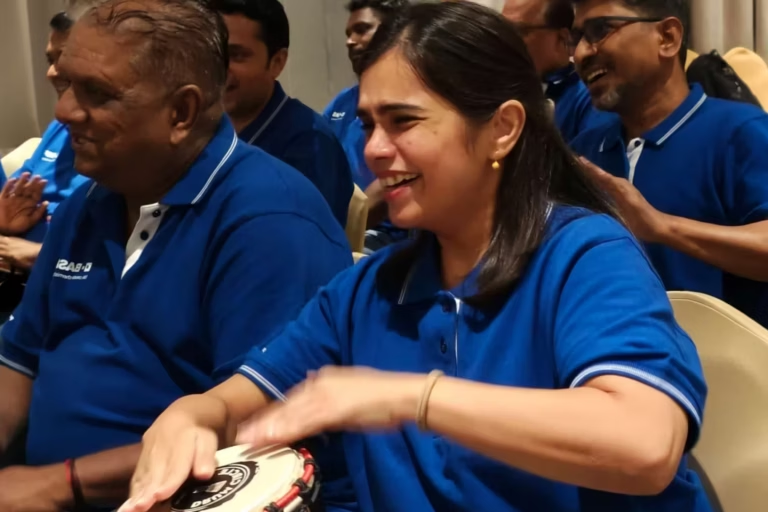
People play seated, with the drum held between the knees, so the layout is mostly about seats and sightlines.
- A circle works for small groups, in a meeting room or a cafeteria. Everyone can see everyone else, and the facilitator stands in the middle.
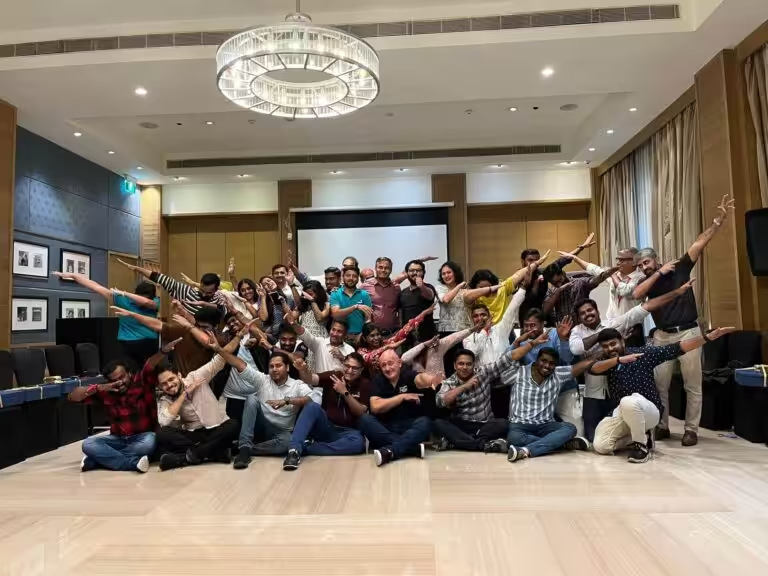
- A horseshoe or several curved rows works in a hall for a few hundred people, with the facilitator at the open end.
- Theatre rows work for large halls and auditoriums, with the facilitator on the stage. Our drum circle page has a video of a session with 1,000 participants, which shows this layout.
Whatever the layout, check three things. Everyone needs a clear view of the facilitator, so raise them on a stage or a platform for large groups. Chairs without armrests make it easier to hold a drum. And the aisles must stay wide enough for drums to move along them, and for people to leave if they need to.
Sound and the facilitator
With more than a small group, the facilitator needs a microphone, and the room needs a sound system that reaches the back row. You arrange these. A headset or collar microphone suits the facilitator best, because their hands are busy. Check where the power points are near the stage, and do a sound check before people come in, not during the first speaker’s slot.
We bring the facilitators and the drums and percussion instruments for everyone, and set up and run the session. Large groups need more drums and more facilitators. We work out both from your headcount and layout when we send the proposal.
Handing out and collecting drums
In my experience, this is the part most often left to the day, and the part that most often overruns. Agree it in advance:
- Whether drums go on the seats before people arrive, or are handed out at the doors, or passed along the rows.
- Who helps. For a large hall, a few people from your team who know the venue speed things up.
- How collection works at the end. Asking people to leave drums on their seats, rather than carrying them out, keeps the exits clear.
- Where the drums are stored before and after the session, if the hall is in use for other sessions.
Noise, neighbours and comfort
A drum circle is loud, which is part of the point. Tell neighbouring teams, floors or halls in advance. In a hotel, ask what else is booked in the halls next to yours at that time. If some participants are sensitive to noise, offer them seats further back, or a shaker instead of a drum, and keep the session to its planned length.
Safety and access
- Exits and aisles: keep them clear of drums and bags throughout. The national crowd management guide (NDMA, 2014) is written for much larger gatherings, but its basics of clear exits, a public address system and a briefed team are good practice for any big session.
- Wheelchair users: plan places on the aisles or at the front, with a drum or a shaker within reach.
- Outdoors: on a lawn, plan shade and drinking water in summer, and a covered back-up space in case of rain.
- Lighting: people need to see the facilitator’s signals, so keep the house lights up rather than dimming the hall as for a presentation.
When drums are not practical
Sometimes the room, the time or the headcount makes drums hard. Body Percussion uses no instruments at all: people clap, tap, snap and stamp to one beat, in 20 to 25 minutes, for 50 to 5,000 people, so there is nothing to hand out or collect. Boombastic is played on light tuned tubes called Boomwhackers, for 50 to 2,500 people in 30 to 40 minutes. For a hall that wants to move, a Dance Workshop teaches an easy routine to groups of 20 to 5,000.
-
 Body Percussion
Ever noticed you carry a full drum kit everywhere? Pepbox’s Body Percussion Experience turns claps, stomps and snaps…
20 to 25 min 50 to 5,000 people
-
 Boombastic
Do. Re. Mi. You hold one note, your colleague holds the next, and together you make real music.
30 to 40 min 50 to 2,500 people
-
 Dance Workshop
Two left feet? Perfect, you’ll fit right in. Pepbox’s Dance Workshop teaches easy, fun Bollywood, salsa and flash mob…
30 to 45 min 20 to 1,000 people
A planning checklist
- Agenda slot fixed, with the session time and the handout and collection time on separate lines.
- Final headcount shared, and the layout chosen: circle, horseshoe or rows.
- Stage or platform for the facilitator, with a clear view from every seat.
- Sound system, a headset or collar microphone, and power points near the stage.
- Handout and collection plan agreed, with helpers named for large groups.
- Aisles and exits clear, and places planned for wheelchair users.
- Neighbouring teams, floors or halls told about the noise.
- For outdoor sessions, shade, water and a covered back-up space.
- One contact person from your side for the facilitator on the day.
We run drum circles across India, including in Delhi, Hyderabad, Pune and Chennai. For the full service, see our corporate drum circle page. Or send us the date, the venue, the headcount and the agenda slot, and we will send a proposal with the layout, the number of facilitators and drums, and the timings.