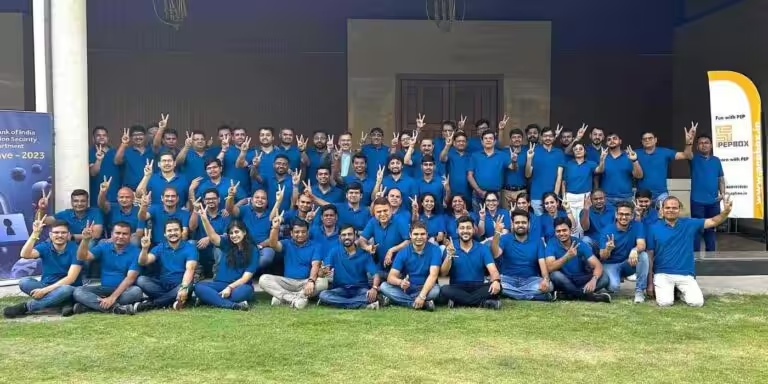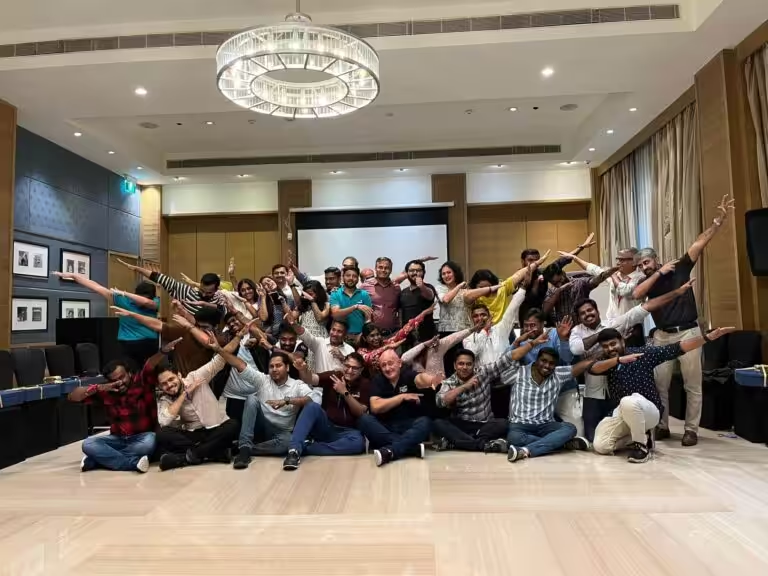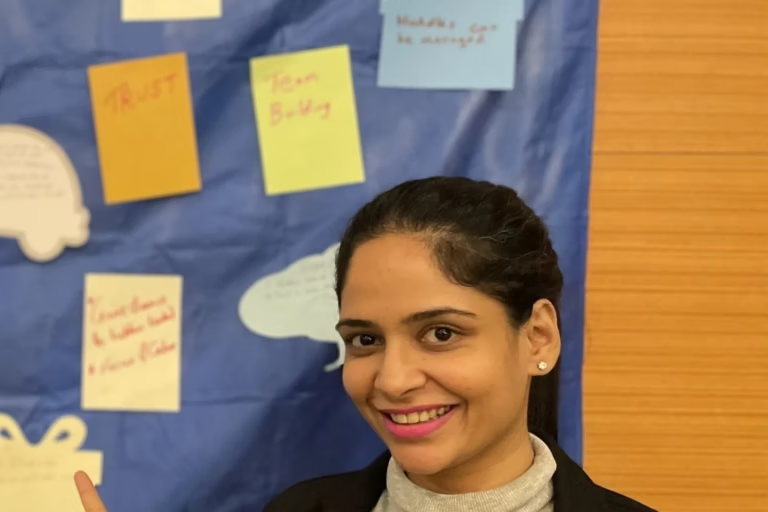
A small team is the easiest group to plan for, and the one where a poor choice shows fastest. With 15 people, nobody can hang back. If the activity only needs four of them, the other eleven stand at the side and watch, and everyone notices.
In this guide, a small group means roughly 10 to 30 people: a department, a project team, a sales region, or a leadership group at an offsite. Most activities on our list are set up for 10 people or more, so that is the range I’ll cover. For each idea you’ll find the time it takes and the group size from our activity pages, so you can check it against your own day.
What changes when the group is small
Three things are different from planning for a hundred people.
- Everyone is visible. Pick activities in which each person has a task. Avoid formats where a few people play and the rest cheer, because in a group of 15 the people watching are most of the room.
- Teams get small. Twenty people work better as four teams of five than as two teams of ten. In a team of ten, two or three people end up doing most of the work.
- You can talk afterwards as one group. With 12 or 20 people you can sit in a circle for ten minutes and ask what helped and what got in the way. That is hard with 200 people, and it is where a small team gets the most out of the session.
The space question also gets easier. A training room, a meeting room with the table pushed aside, or the lawn of a resort is usually enough.
Puzzles and problem solving at a table
If your team is in office clothes and has an hour, start here. These activities run at tables, keep people seated most of the time, and make everyone share what they know.
Escape Room Series is a tabletop escape game. Each team gets a storyline and works through clues and codes against the clock, and it only works if people share what they have found. It takes 60 to 90 minutes and suits 10 to 1,500 people, so a small team simply plays at two or three tables. Perfect Squares is much shorter, 15 to 20 minutes. In teams of five, every player has to complete a square of the same size without speaking, and someone usually has to give up a piece to help a colleague. NexGen Board Games are large strategy boards run by our game masters, built around business decisions, for 10 to 150 people in 20 to 40 minutes.
-
 Escape Room Series (In Person)
A table, some puzzles and a ticking clock. Pepbox’s tabletop Escape Room Challenge has teams cracking codes together…
60 to 90 min 10 to 1,500 people
-
 Perfect Squares
Rule one: make five identical squares. Rule two: no talking. Rule three: you can only give, never take.
15 to 20 min 10 to 200 people
-
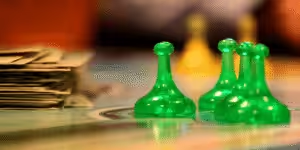 NexGen Board Games
Read the board, weigh the risks, trust your team and make your move.
20 to 40 min 10 to 150 people
There are more of these on our list of problem-solving activities.
Build something together
Build challenges give a small team a shared goal and a clear test at the end: it either works or it doesn’t. They also show quickly who plans, who builds and who checks the time.
In Rollercoaster Building, each team builds a track from simple materials, and the test is whether a ball runs along it from start to finish. Plan 75 to 90 minutes for it. Sunny Side is an egg drop: teams design a device that stops a raw egg from breaking when it falls, in 45 to 60 minutes. Both work for 10 to 200 people.
-
 Rollercoaster Building
You must be this collaborative to ride. Pepbox’s Rollercoaster Building has teams design, build and test a working…
60 to 100 min 10 to 200 people
-
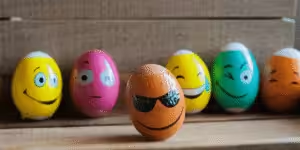 Sunny Side
Protect the egg. Protect the data. Protect your team’s hard-earned pride.
45 to 60 min 10 to 250 people
One decision to make before the day: does the manager play or judge? In a small team, a senior person who plays tends to end up running the build. Asking them to judge keeps the build in the team’s hands.
Hands-on workshops
Workshops are the calm option. A facilitator teaches a craft step by step, and each person makes something of their own while they chat. Several of ours take up to 40 or 50 people, which makes them a good match for a small group, and they need little more than tables.
At a Terrarium Workshop, each person builds a miniature garden in a glass container, in 45 to 60 minutes. Pottery puts people on a potter’s wheel with a live potter guiding them, for 30 to 45 minutes, and no experience is needed. Mixology starts with a short lesson from a bartender, then teams create their own cocktails or mocktails at their own counters. It suits 10 to 40 people and takes 30 to 45 minutes. If your team likes food, MasterChef Challenge has teams earn their ingredients through challenges before they cook.
-
 Terrarium Workshop
Care instructions: water lightly, keep near gentle sunlight, admire every single day.
45 to 60 min 10 to 50 people
-
 Pottery
Wobbly bowl? Lopsided mug? Perfect. Pepbox’s hands-on Pottery Workshop is about slowing down, getting your hands messy…
30 to 45 min 10 to 50 people
-
 Mixology
Here’s to the team that mixed the perfect mocktail, named it after their manager and toasted together.
30 to 45 min 10 to 40 people
You will find the others on our list of creative team building activities.
Outdoor games for a small team
At an offsite with a lawn, a small group can play games that would be chaos with a few hundred people. Ask about fitness first, though, because with 15 people one person sitting out is very visible.
Homerun mixes cricket and baseball: teams bat with cricket bats but follow baseball rules, which causes a lot of confusion at first and some quick changes of tactics. It is high energy, for 10 to 50 people, and takes 15 to 20 minutes. Landmines is slower: a blindfolded player crosses a field of cones and balls, guided only by teammates calling out directions. It suits 10 to 70 people and takes 30 to 45 minutes. In Blind Caterpillar, a blindfolded team moves through a course in a line while one teammate guides it without words, and everyone takes a turn as the guide.
-
 Homerun
What if cricket played by baseball’s rules? Homerun! is Pepbox’s hilarious mash-up where familiar bats meet unfamiliar…
15 to 20 min 10 to 50 people
-
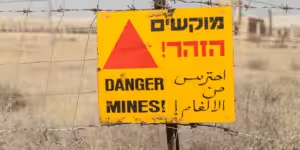 Landmines
Blindfold on. Mines everywhere. One voice to trust. Landmines is Pepbox’s nail-biting team building challenge where…
30 to 45 min 10 to 100 people
-
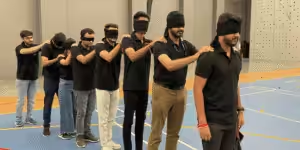 Blind Caterpillar
Blindfolded, arms linked and not a word allowed. Blind Caterpillar is Pepbox’s silent team building challenge where…
30 to 50 min 10 to 400 people
Blindfold games are worth a quick check with the group before the day. Some people are not comfortable being blindfolded, and they can take the guiding role instead. Our outdoor team building list has more options.
When the team works from different cities
Small teams are often spread out: two people in Pune, four in Bangalore, one working from home in Jaipur. An online session is the simplest way to get everyone together, and our virtual activities run on Zoom, MS Teams, Google Meet or Webex.
Virtual Escape Room Series is the online version of the tabletop game, for 60 to 90 minutes. Teams can only win by sharing what each person sees on screen. Crime Scene Investigation (Virtual) is a detective game with crime scene rooms, evidence and suspect files, and takes 75 to 90 minutes. Around the World is shorter, 50 to 70 minutes: teams study street scenes from cities around the world and pin their guess on a map.
-
 Virtual Escape Room Series
Next episode starts in five, four, three… Pepbox’s Virtual Escape Room Series gives remote teams a brand-new storyline…
60 to 90 min 10 to 500 people
-
 Crime Scene Investigation (Virtual)
It wasn’t the butler. Probably. Pepbox’s virtual Crime Scene Investigation Challenge turns remote teams into…
75 to 90 min 10 to 200 people
-
 Around the World
Boarding pass: destination, everywhere. Fuel: your own footsteps.
50 to 70 min 10 to 300 people
With eight to twelve people online, two teams are usually enough. Ask everyone to test the link and their audio the day before. More ideas are on our virtual team building list.
Putting the session together
One of our sessions in Kashid, on the Konkan coast, had about 35 people. We kept it light: short interactive games and challenges in small teams, where each team had to make decisions together and compete in a friendly way. With a group of that size, I prefer a few short rounds to one long activity. If you reshuffle the teams between rounds, people end up working with most of their colleagues by the end of the day.
A few other points that help with a small group:
- Time: in the office, 60 to 90 minutes is enough. At an offsite, a half day leaves room for two formats, for example a table puzzle in the morning and a workshop after lunch.
- Teams: four to six people per team. Put people who don’t usually work together in the same team.
- The talk at the end: keep 10 to 15 minutes for it and protect that time. It is the part a small team gets the most from, and the first thing to be cut when lunch runs late.
- The people: tell the facilitator in advance about anyone with limited mobility, an injury or a pregnancy, so the activity can include them.
If you are planning for a particular occasion rather than a particular group size, our guide to corporate team building event ideas sorts the options by occasion instead.
All the ideas at a glance
| Activity | Time | Group size | Where |
|---|---|---|---|
| Escape Room Series | 60 to 90 min | 10 to 1,500 | Indoors, at tables |
| Perfect Squares | 15 to 20 min | 10 to 200 | Indoors or outdoors |
| NexGen Board Games | 20 to 40 min | 10 to 150 | Indoors, at tables |
| Rollercoaster Building | 75 to 90 min | 10 to 200 | Indoors or outdoors |
| Sunny Side | 45 to 60 min | 10 to 200 | Indoors or outdoors |
| Terrarium Workshop | 45 to 60 min | 10 to 50 | Indoors |
| Pottery | 30 to 45 min | 10 to 50 | Indoors or outdoors |
| Mixology | 30 to 45 min | 10 to 40 | Indoors |
| Homerun | 15 to 20 min | 10 to 50 | Outdoors |
| Landmines | 30 to 45 min | 10 to 70 | Indoors or outdoors |
| Blind Caterpillar | 30 to 45 min | 10 to 300 | Indoors or outdoors |
| Virtual Escape Room Series | 60 to 90 min | 10 to 500 | Online |
| Around the World | 45 to 60 min | 10 to 400 | Online |
If you are still deciding, send us the headcount, the place and the time you have, and we’ll suggest two or three activities that fit. You can also browse all our activities and filter them by group size, setting and duration.